
For the last twenty years, companies have used wikis to store information. The concept is simple: you create a page, write down how something works, and save it in a folder.
But as the pace of work accelerates, the wiki model is showing its age. Today’s teams don't just need a place to store text; they need an engine that actively surfaces answers.
The Passive Nature of Wikis
The fundamental flaw of a traditional wiki is that it expects the user to do the heavy lifting.
If you are a new hire looking for the company holiday schedule, a wiki requires you to know how the folder structure was organized by whoever built it three years ago. Is it under "HR"? "People Ops"? "Onboarding"? "General Info"?
By forcing employees to navigate arbitrary folder trees, passive wikis create friction. When friction gets too high, employees abandon the wiki and go straight to Slack to ask a human.
Enter the Knowledge Engine
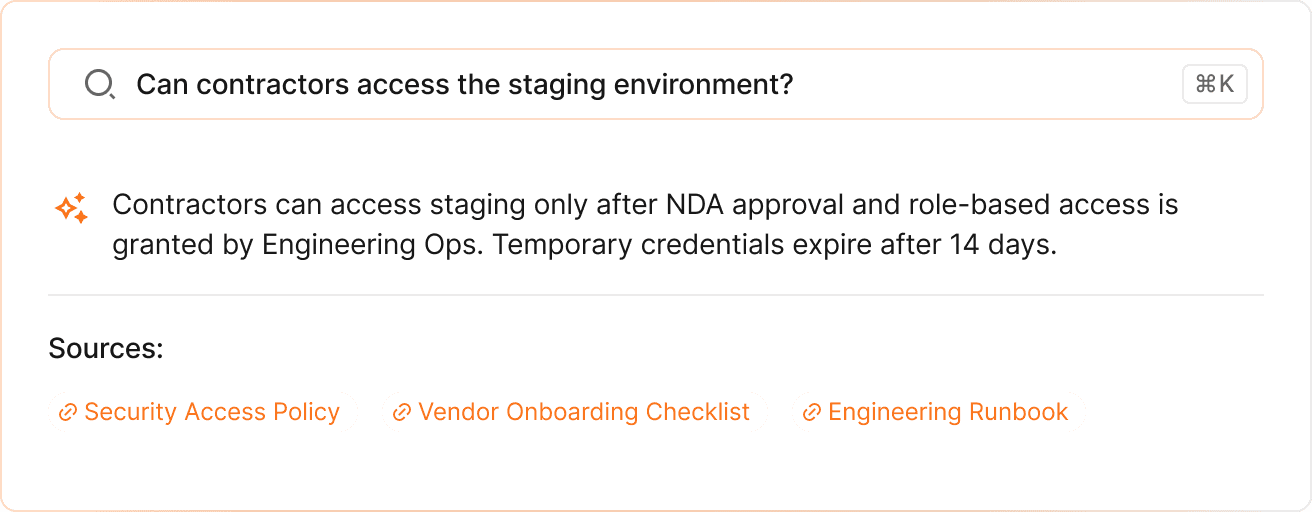
A knowledge engine flips the model. Instead of making the user navigate to the document, the engine brings the exact answer to the user.
Search that understands intent
Unlike keyword search, an AI-powered engine understands semantic intent. If someone asks, "How do I get a new monitor?", the engine knows this is related to "hardware procurement" or "IT expensing," even if those exact words aren't in the query.
Answers over links
A traditional wiki gives you a list of ten blue links and says, "Good luck reading these." A knowledge engine reads the top three verified documents and generates a concise, two-paragraph answer, followed by the source links if you need to go deeper.
We built Slivo because we believe the era of the passive wiki is over. Teams don't want to browse folders; they just want the answer.